If your practice or business is still paying for a landline system with a server…
A Simple Internet Plan Comparison Guide for Australian Families and Small Businesses
Choosing an internet plan comparison in Australia shouldn’t feel like decoding a phone bill. Between speed tiers, contract terms, and provider marketing that all sound the same, it’s easy to end up paying for more than you need or, worse, less than you need when it matters. This guide breaks down how NBN plans really work, what families should look for, and what small businesses (especially medical practices juggling telehealth, patient records, and payments) need to get right before they sign up.
How NBN Plans Actually Work
Australia’s National Broadband Network (NBN) is wholesale infrastructure you don’t sign up for directly. Instead, retail providers like Aussie Broadband, Telstra, TPG, or Tangerine buy access to the network and resell it under their own plans and pricing. That’s why two providers can advertise the “same” NBN 100 plan at very different prices and very different real-world performance.
Your actual connection type (fibre to the premises, fibre to the node, HFC cable, fixed wireless, or satellite) depends on where you live or work, and it affects the maximum speed available to you before you even start comparing providers.
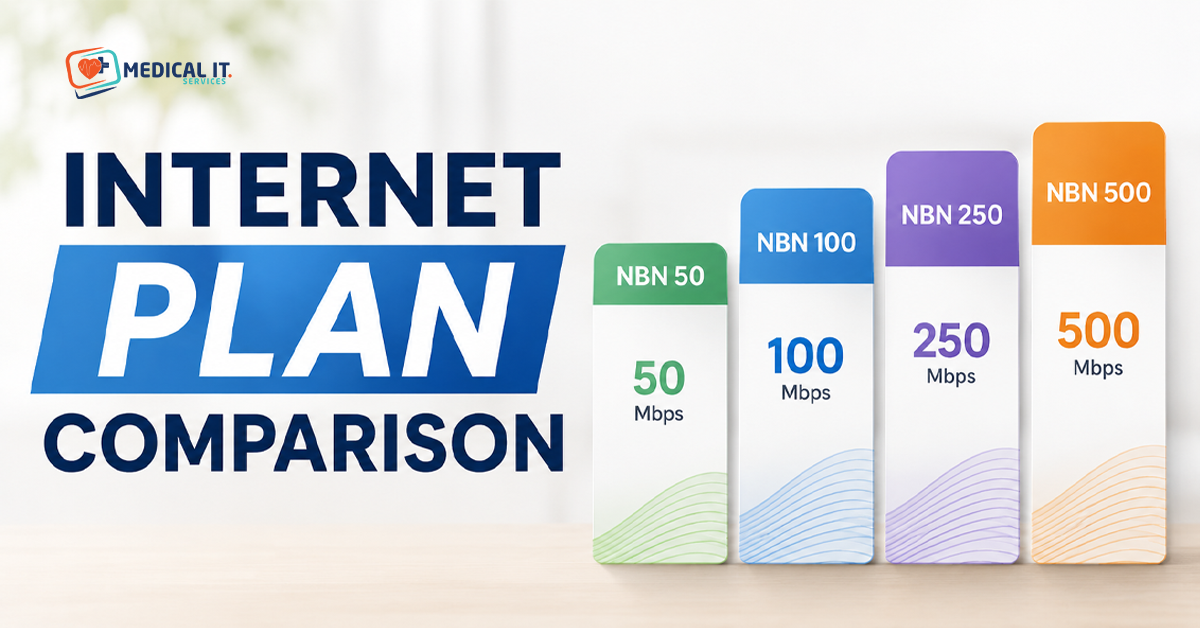
Speed Tiers Explained: NBN 50, 100, 500 and Beyond
The tier name on a plan (like NBN 100) is the theoretical maximum, not what you’ll get during the busiest part of the evening. A useful comparison always looks at typical evening speed and real performance between 7 pm and 11 pm, when everyone in the neighbourhood is online at once.
| Tier | Best For |
| NBN 25 | Light use: browsing, email, one person streaming |
| NBN 50 | Small family streaming HD and video calling — most popular tier |
| NBN 100 | Busy households or a small office with several people working, uploading, streaming at once |
| NBN 500 | Large, always-connected households or offices moving large files regularly |
| NBN 750/1000+ | Heavy users, larger clinics or offices with many simultaneous cloud systems |
Family Internet
Most Australian households don’t need the fastest plan available; they need a plan that holds up during peak hours. For a couple or small family streaming, browsing, and video calling, NBN 50 is usually a sweet spot. Larger households with several people gaming, streaming 4K, or working from home at the same time often get better value stepping up to NBN 100.
Two things matter more than the headline speed number:
- No lock-in contracts: month-to-month plans keep providers accountable and let you switch if service drops.
- Evening speed consistency: a provider that buys enough network capacity holds close to the advertised speed at 8 pm; one that doesn’t will slow to a crawl exactly when you need it most.
Small Business Internet:
For a small business, internet isn’t a convenience; it’s infrastructure. Cloud accounting software, VoIP phone systems, card payments, and video meetings all depend on a stable connection. A dropout that’s a mild annoyance at home can mean a missed payment, a dropped client call, or a booking system going offline.
When comparing plans for a business, weigh:
- Team size and simultaneous use: more people online at once need more headroom.
- Upload speed: often overlooked, but critical for video calls and cloud backups.
- Support response times: a business plan with faster fault escalation is worth paying for if downtime costs you money.
- Can the plan grow with the business without a full re-signup?
Why Medical Practices Need to Think Differently About Connectivity
A general practice, specialist clinic, or allied health provider carries a different risk profile to almost any other small business. Patient records are stored and accessed in the cloud. Telehealth consultations depend on a stable video connection. Practice management and billing software often run continuously throughout the day. If the internet drops, it’s not just inconvenient; it can mean a missed telehealth appointment, a delayed prescription, or exposed downtime in systems that hold sensitive patient data.
This is where a straightforward broadband comparison isn’t enough. Practices need to weigh connectivity decisions alongside their broader IT and data security setup, including how patient information is protected, backed up, and accessed securely by staff working across multiple devices or locations.
Business NBN vs Residential NBN
Briefly, business and residential NBN plans can look similar, with the same tier names and similar price ranges. The real differences show up once a connection is under pressure:
- Lower contention ratios on business plans, meaning fewer other users sharing the same network capacity.
- Priority fault restoration, often with defined response-time commitments.
- Static IP availability, useful for remote access, security cameras, or hosted software.
- Backup connectivity options, such as 4G/5G failover, so a fixed-line outage doesn’t take the whole practice offline.
For a clinic or office where downtime affects patients or revenue, the extra cost of a business-grade plan is usually smaller than the cost of an afternoon offline.
What Official Data Says About Provider Performance
It’s worth comparing plans using independent data rather than provider marketing alone. The ACCC’s Measuring Broadband Australia program, which ran from 2018 until its final report in June 2026, tracked real-world NBN performance across thousands of Australian households using independent testing hardware.
Its final report found that NBN fixed-line connections delivered an average of 99.4% of their plan’s download speed during busy evening hours, up from 98.5% in the prior report and a marked improvement on the 80–85% typically recorded in the program’s early years. The proportion of underperforming fixed-line services also dropped sharply over the life of the program, from 13.9% in 2018 to 5.6% in the final report. Fixed wireless connections were also shown to be a strong option for locations outside the fixed-line footprint, with the most popular fixed wireless plan approaching close to 100 Mbps during peak hours.
The takeaway: today’s NBN fixed-line network is far more reliable than it was even a few years ago, but performance still varies meaningfully by provider and connection type, which is exactly why comparing typical evening speeds, not advertised maximums, matters.
Conclusion
A good internet plan comparison isn’t about chasing the biggest number on the page; it’s about matching real-world speed, reliability, and support to how you use your connection, whether that’s household streaming in the evening or a clinic running telehealth and patient records all day. For families, that usually means NBN 50 or 100 on a no-lock-in plan. For small businesses and medical practices, it means weighing business-grade reliability, backup connectivity, and how that connection fits into your broader IT and data security setup.
If your practice’s internet plan is due for a rethink or you’re not sure your current setup can support telehealth, cloud records, and daily operations securely, Medical IT Services can review your connectivity alongside your broader IT and cybersecurity needs and recommend a setup built for healthcare, not guesswork. Get in touch for a free IT assessment.
Related Posts