Why IT Support for Healthcare Requires Specialised Knowledge of Clinical Systems and Patient Privacy
Most managed IT providers list healthcare as one of several industries they serve, right alongside…


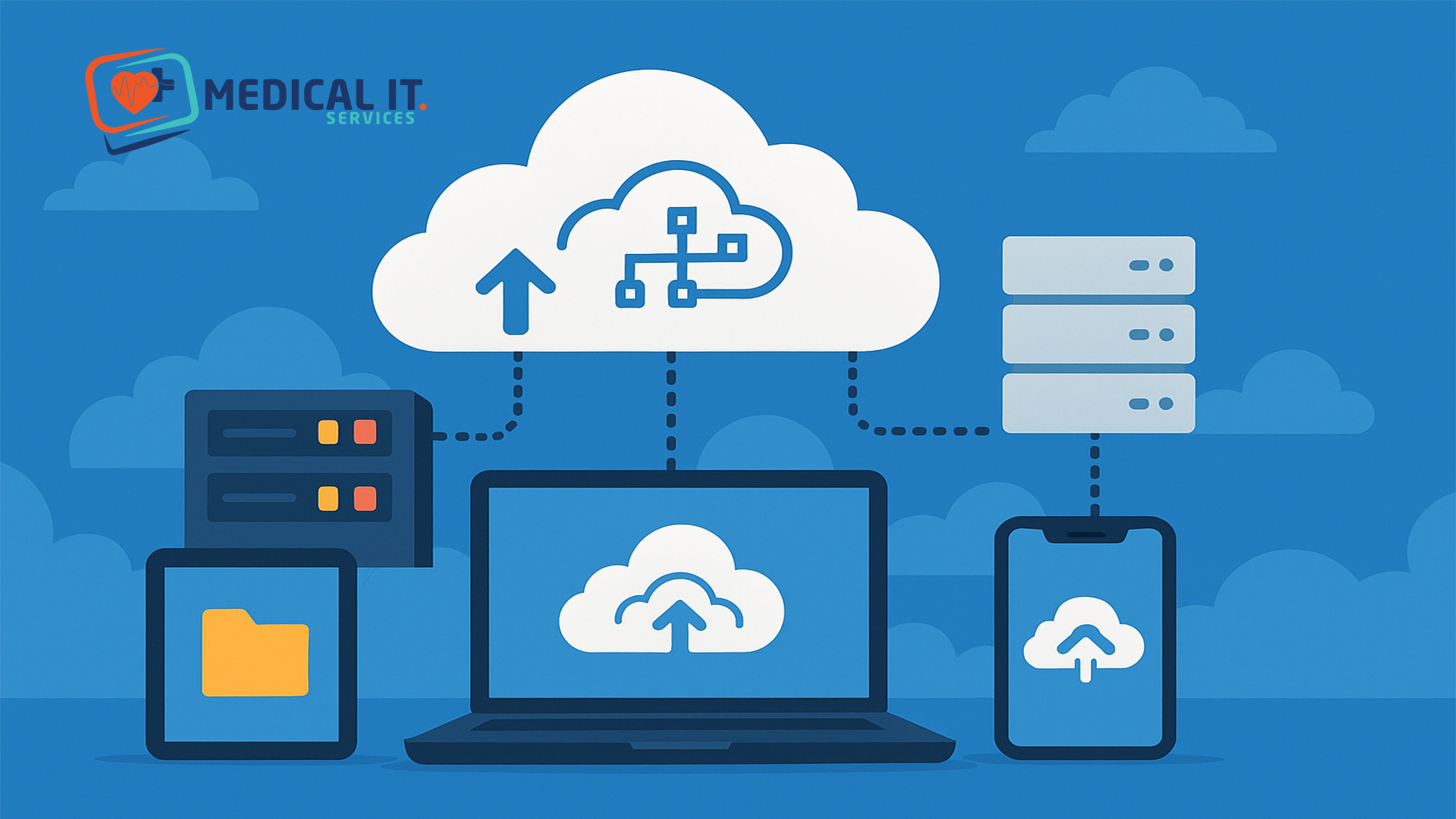
Cloud hosting is a service that provides storage, computing power, and software over the internet. Instead of relying on a single physical server in a basement, use a vast network of virtual servers located in secure data centers around the world.
Why has this become essential? For modern businesses and individuals, cloud hosting is no longer a luxury; it’s the backbone of how we work and live. It allows a small startup to access the same computing power as a giant corporation, lets you access files from any device, and enables the apps on your phone to update seamlessly. However, not all cloud hosting is the same. Depending on specific needs—like budget, security, and control- there are different types of cloud hosting designed to provide the perfect fit.
Traditional hosting was used by organizations before the advent of cloud computing, often on a single physical server. This was like living in a home where you were responsible for all the enhancements, repairs, and upkeep that were performed. If the company needs more space, you are required to physically construct an expansion, which is a time-consuming and costly process.
In this respect, cloud hosting completely changed everything. Here’s an explanation of why it’s better and different:
Public cloud hosting can be compared to renting an apartment in a large building. In this approach, a third-party provider—such as AWS, Azure, or Google Cloud—owns and manages the infrastructure, including servers, storage, and networking equipment, which is shared among many users. Like a utility bill, you only pay for the computing power, storage, and bandwidth that you need to access and manage online services.
This model is particularly beneficial for startups, development projects, and applications that experience unexpected traffic, as it provides cost-effectiveness and tremendous scalability. While public cloud hosting provides benefits, it may offer less flexibility and control compared to other hosting models because of the shared hardware. Although typically secure, public cloud hosting may not satisfy data sovereignty and security requirements without proper setup.
Private cloud hosting is like home security. Only one company may use this computer infrastructure. It might be hosted by a third party or in its own data facility. Private cloud hosting allows the organization exclusive access to all its resources since each tenant is isolated from the others.
Private cloud hosting gives government agencies, banks, big businesses, and anyone who must follow rigorous industry rules the greatest privacy, control, and freedom. It costs more to set up and run than public clouds, and it doesn’t scale as well. To increase capacity, you need to buy and set up more gear.
Public and private clouds are brought together in hybrid cloud hosting, which makes it possible to transfer data and applications across the two types of clouds. Strengthened networking and virtualization provide the foundation for this adaptable environment, which enables workloads to be moved according to the requirements of cost, security, and performance.
The critical workloads of an organization may be kept in a private cloud that is secured from unauthorized access. On the other hand, the public cloud may be used for applications that are less vital or for the management of enormous amounts of traffic. On the other hand, managing a hybrid environment may be a tough undertaking that requires technologically sophisticated tools and a high level of competence to ensure smooth integration and consistent security across all platforms. This is because hybrid environments are characterized by a combination of different types of environments.
A multi-cloud hosting strategy includes using cloud services from two or more separate public cloud providers. For example, employing Amazon Web Services (AWS) for machine learning, Google Cloud for data analytics, and Microsoft Azure for its productivity suite are all examples of multi-cloud hosting strategies. Unlike hybrid clouds, this technique often utilizes numerous public clouds rather than a combination of private and public clouds. This distinguishes it from the hybrid cloud approach.
It is largely for the purpose of avoiding vendor lock-in that businesses pursue a multi-cloud approach. This not only boosts their bargaining power for better pricing. But also protects them from being dependent on a single provider. The ability to pick the best-in-class services from a variety of providers for certain jobs is another benefit that it offers to enterprises. This technique, on the other hand, might add complexity to management since it requires knowledge in a variety of platforms and technologies to monitor expenses, security, and compliance in a consistent manner across a variety of settings.
Managed cloud hosting is a kind of service in which a cloud service provider or a specialized partner is constantly in charge of running, maintaining, and supporting cloud infrastructure. They not only provide gear, but they also provide important services like constant monitoring, security upgrades, data backups, performance optimization, and professional help. This model acts like another person on the IT team.
This approach will help companies that don’t have a lot of competent IT professionals. Or it would prefer to have their present staff focus on huge projects instead of dull IT chores. With regulated hosting, skilled experts handle chores, which makes them simpler to perform. It may also protect and speed things up, however. It is generally linked to a higher cost and needs more direct control over the environment, on the other hand.
Selecting the right cloud model begins with a clear assessment of security and compliance needs. If a company deals with extremely sensitive data, such as financial records or personal health information. A private or hybrid cloud provides the essential control and isolation that is required. A public cloud’s comprehensive security is often adequate and more cost-effective for less sensitive data or ordinary commercial applications. This is because public clouds are more widely available.
The next step is to assess the practical and budgetary limitations you face. Think about the information technology skills you have in-house; if you do not have a dedicated staff, Managed Cloud Hosting or a public cloud PaaS (Platform as a Service) that is user-friendly may release you from the weight of technical responsibilities. When it comes to upfront expenditures, the pay-as-you-go public cloud is the most cost-effective option. On the other hand, a predictable workload may be sufficient to justify the investment in a private cloud hosting service. A multi-cloud approach should also be considered to avoid being dependent on a single provider. And to make the most of the services offered by each of the vendors.
Finally, be sure that the selection is in line with the objectives and development trajectory of the company. Because of the public cloud’s capacity to scale, a company or project that experiences changing demand. It can profit tremendously from using it. A method that is hybrid method may be necessary for a big business to successfully blend cloud innovation with older systems. The choice you make is not a permanent one; rather, it is a strategic option. That ought to promote operational efficiency, agility, and development over the long run.
The cloud environment provides a wide range of solutions that may be adapted to meet a variety of requirements. The public cloud offers more scalability and cost-efficiency than any other cloud. The private cloud offers the highest possible level of protection and control, and the hybrid cloud combines. All these advantages to give the greatest possible degree of flexibility. In the meantime, multi-cloud solutions reduce the risk of being locked in with a single provider. And managed cloud services relieve the burden of technical management. The first step in selecting what is in the best interest is to understand the fundamental purpose of each model.
A delicate balancing act between the specific requirements for security, compliance, money, and in-house knowledge. It is ultimately what will determine which option is the best one to go with. A universally applicable solution does not exist. But you will be able to pick a foundation that not only satisfies present demands. But also easily grows to support future success if you carefully evaluate business goals. And technological requirements in comparison to what each form of cloud provides.