If your practice or business is still paying for a landline system with a server…
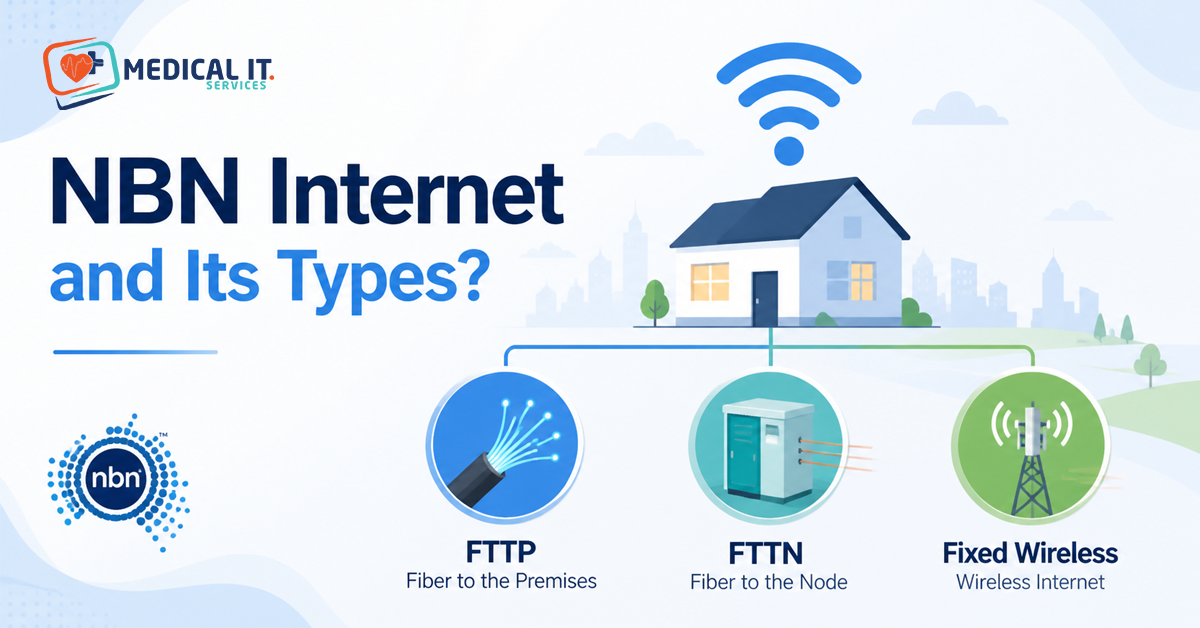
Understanding NBN Internet Technology Types From FTTP to FTTN and Fixed Wireless
In today’s world, fast and reliable NBN Internet has become an important part of our daily lives. Good internet is essential for online learning, work, watching videos and keeping in touch with others. To meet this need, Australia has built the NBN (National Broadband Network), which provides internet to homes and offices through various technologies. Its aim is to provide better and faster internet to people in every area.
But most people do not understand what FTTP, FTTN and Fixed Wireless are. These are different ways of providing internet. In FTTP, the fibre cable comes straight to the home and is the fastest. In FTTN, the fibre comes to the neighbourhood and the rest of the way is through old wires, so the speed may be slow. Whereas in Fixed Wireless, internet is provided through a signal without wires, which is mostly used in rural areas.
What is FTTP (Fiber to the Premises)?
FTTP is a modern and high-speed internet technology that is considered the best in today’s era. In this, a fiber optic cable is delivered directly to your home or office. Fiber cable is a special type that transmits data through light, which is why its speed is much higher than ordinary wires. Since the connection comes directly to you, there is no problem with any intermediate obstacles or old wires, and the internet runs much cleaner and faster.
How does it work?
In this system, the company lays a special fiber line that comes directly to your home or office. This line loses very little signal, due to which the internet speed remains the same. It also has very little distance effect, meaning whether you are in the city or a little further away, the speed is not affected much.
Advantages
The biggest advantage of FTTP is its high speed. On it, you can easily watch HD and 4K videos, play online games without stopping, and video calls also run smoothly. Even if several people in the house use the internet at the same time, the speed does not decrease much.
Another important advantage is that it is stable. Frequent internet downfalls or weak signals are less common here. That is why it is a great option for businesses, freelancers, and those who work online.
In addition, it is also better for the future, because as technology advances, FTTP can easily support higher speeds.
Disadvantages
Although FTTP is a great technology, it also has some disadvantages. The biggest problem is that it is not available everywhere. Especially in rural or remote areas, laying a fiber line is difficult and expensive, so this service cannot reach there.
Another disadvantage is its cost. It costs more to install fiber cables and prepare the system, which can also make it more expensive for consumers.
In some areas, installation can also take time, because laying a new line is not an easy task.
What is Fixed Wireless?
Fixed Wireless is a method of providing internet without wires. It is specifically designed for areas where it is difficult to lay fiber or cable, such as rural or remote areas. In this technology, internet access is provided through signals like a mobile network, but it is more stable than normal mobile data because it is for a specific location (home or office).
How does it work?
This system has a tower that sends internet signals. A special antenna is installed on your home or building that receives these signals. This signal then reaches your mobile, laptop or other devices through a router. For this, it is necessary that there is a direct line of sight between the tower and the antenna so that the signal reaches without obstruction.
Advantages
The biggest advantage of Fixed Wireless is that it is the best solution for rural areas where services such as fiber or DSL are not available. It does not require laying cables, so installation is relatively easy and fast.
In addition, it is also a good option for those who want a quick internet connection or where digging a line is not possible. In many cases, it can even provide better performance than regular DSL.
Disadvantages
A major problem with this technology is that it is affected by the weather. In the event of rain, wind or fog, the signal can be weak, which slows down the internet. Similarly, the speed is not always the same. If more people are connected to the same tower, the speed can be reduced. Another important thing is that there should not be any large obstacles (such as buildings or trees) between the tower and your home, otherwise the signal may be affected.
| Technology | Speed | Stability | Usage / Best For |
| FTTP (Fiber to the Premises) | Very fast (up to 1 Gbps or more) | Excellent, very reliable connection | Best for homes and businesses, streaming, gaming, heavy internet use |
| FTTN (Fiber to the Node) | Medium speed (depends on distance) | Normal, can slow down sometimes | Good for general home use like browsing, YouTube, and social media |
| Fixed Wireless | Varies (can be slow or fast) | Depends on weather and signal strength | Best for rural and remote areas where cables are not available |
Related Posts