Why IT Support for Healthcare Requires Specialised Knowledge of Clinical Systems and Patient Privacy
Most managed IT providers list healthcare as one of several industries they serve, right alongside…


Today, almost everyone uses mobile phones, computers and the Internet. These are the devices that we use to save our critical files, as well as our photographs, videos, and bank information. On the other hand, the Internet is home to malicious viruses and hackers that can steal your data or cause you to experience system damage. The utilisation of anti-virus software is of utmost significance for this reason. It safeguards both your mobile device and your computer from potentially hazardous infections.
Antivirus monitors your system all the time. If a dangerous file, virus or suspicious website is encountered, it immediately warns or blocks it. Modern antiviruses also detect new viruses and protect your personal information. If the antivirus is updated on time, it provides better protection against hacking and cyber attacks.
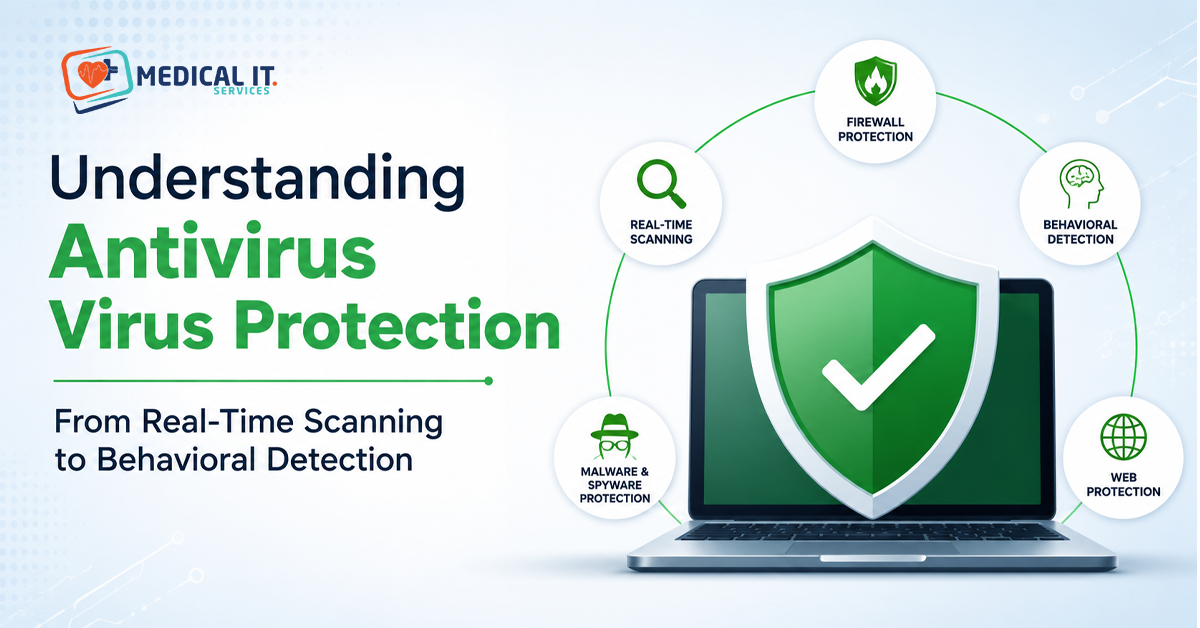
Real-time scanning is a very important feature of an antivirus that keeps an eye on your computer or mobile all the time. Its function is that as soon as you download a new file, plug in a USB, open an e-mail or visit a website, the antivirus immediately checks that there is no virus or dangerous file in the computer.
If the antivirus detects something suspicious, it immediately warns you. Sometimes it even blocks or deletes the dangerous file automatically so that it doesn’t harm your system. In this way, the virus is caught before it spreads to the computer.
Due to real-time scanning, your data is more secure and protected from hackers’ attacks. This function helps to prevent slowdowns of the computer, corruption of files, and theft of personal information. If this feature is turned off, viruses will have an easier time entering the system; therefore, it should be turned on at all times.
Behavioral detection is an advanced antivirus security feature that helps identify new and dangerous viruses. Many times there are new viruses that the antivirus does not already have information about. In such situations, conventional scanning does not catch them immediately, but behavioral detection detects the threat based on their behavior.
This feature looks at how a file or program works rather than its name. If a program suddenly starts deleting files, repeatedly opens strange pop-ups, changes computer settings or tries to steal confidential information, the antivirus immediately considers it suspicious.
After that, the antivirus software either prevents the program from running or alerts the user to ensure that the system remains secure. When it comes to protecting against ransomware, hacking, and new viruses, this function is very important. Due to this particular reason, behavioral detection is of the utmost significance in modern antivirus software.
A firewall is a security system that acts as a strong wall between your computer and the Internet. The primary objective of this tool is to monitor all of the data that is arriving and leaving from the internet on your system. A connection that is considered potentially harmful or suspicious will be promptly blocked by the firewall.
When you use the Internet, many websites and programs try to connect to your computer. The firewall does not allow every connection, but only secure and necessary connections. This way hackers or unnecessary programs cannot enter your system.
A firewall has many benefits. It protects you from hacking, blocks illegal access and secures your data. Also, it keeps internet usage more secure and under control. If your computer does not have a firewall, it is quite likely that it will be susceptible to hostile assaults. Consequently, it is essential to ensure that the firewall is constantly turned on.
Malware and spyware are dangerous programs that sneak into your computer or mobile and try to steal your personal information. They can access your passwords, bank account details, photos and other important data, which can cause you great harm.
Antivirus helps identify and eliminate these dangerous programs. It continually scans your system and when it discovers any questionable file or program, it disables or deletes it instantly. This way your data is protected.
Due to this protection, your privacy is protected and hackers cannot access your information easily. If this feature is not available, viruses and spyware can silently enter your system and cause damage. Therefore, this feature is considered very important in antivirus.
Web Protection is an important antivirus feature that helps keep you safe on the Internet. Today there are many fake and dangerous websites that trick people into infecting their computers or mobile phones or stealing their personal information.
Modern antiviruses already recognise these websites and prevent you from visiting them. When you open a website, the antivirus analyses whether it is safe or not. Also, if the website is dangerous, it immediately warns or blocks it.
Web protection has many benefits. And it gives you a secure browsing experience, protects against phishing attacks and makes online shopping more secure. Because of this, your personal information, such as passwords and bank data, is protected from theft. Therefore, web protection is very important when using the Internet.
When choosing an antivirus, keep these things in mind:
Antivirus is not just a software but an important tool to protect your digital data. Real-time scanning, behavioural detection, firewalls, and web protection are some of the features that play a significant part in ensuring the safety of your computer and the information you are personally responsible for.
Be careful to protect yourself from any cyber attacks by using a reliable and up-to-date antivirus program whenever you use the Internet.