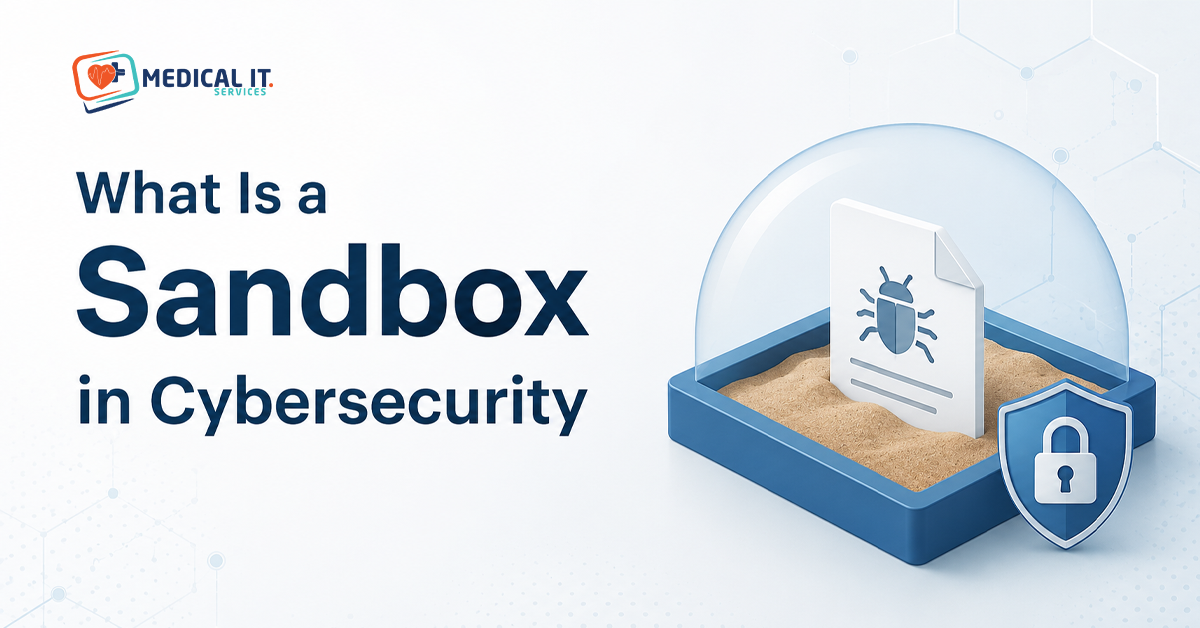
A sandbox in cybersecurity is a safe, isolated space where a suspicious file or link…
Why IT Support for Healthcare Requires Specialised Knowledge of Clinical Systems and Patient Privacy
Most managed IT providers list healthcare as one of several industries they serve, right alongside retail, hospitality, and professional services. That’s precisely the problem. IT support for healthcare requires specialised knowledge of clinical systems and patient privacy, not general troubleshooting skills applied to a slightly different logo. This article explains what that specialised knowledge looks like, and what genuinely goes wrong without it.
What Healthcare Experience Actually Means, Beyond a Bullet Point
Almost every managed IT provider’s website lists healthcare as one of the industries it serves. Very few explain what that experience consists of. Genuine healthcare IT experience means understanding the named clinical systems, patient privacy obligations specific to health information, and the operational reality that a clinic can’t simply wait until Monday to fix a problem, as a retail store might. Without these specifics, “healthcare experience” is just a word on a page.
Understanding Clinical Systems, Not Just Generic Software
Medical practice doesn’t run generic office software; it runs Best Practice Software, Medical Director, or Genie Solutions, each with its own quirks, update cycles, and integration requirements with things like HotDoc and My Health Record. An IT provider unfamiliar with these systems is troubleshooting blind, treating a practice management software issue the same way they’d treat a generic accounting program problem, when the two have almost nothing in common operationally.
Patient Privacy Is Not the Same as General Business Data Protection
Every business handles some customer data. A medical practice handles health information, which carries specific obligations under the Privacy Act 1988, including the Australian Privacy Principles, that go well beyond generic data protection good practice. An IT provider without healthcare-specific knowledge may not realise that a routine troubleshooting step, remotely accessing a workstation, exporting a data sample to diagnose an issue, needs to be handled differently when patient health information is involved.
What Happens When a Generalist IT Provider Gets It Wrong
- A practice management software update is applied without understanding its specific interaction with a clinic’s existing configuration, causing unexpected downtime during consulting hours.
- A backup solution is configured adequately for generic files but doesn’t account for the specific structure or retention needs of clinical records.
- A remote access fix is performed without appropriate care for patient data visible on-screen during the session.
- An IT provider recommends a technically sound but compliance-blind solution, unaware it conflicts with RACGP or NSQHS expectations.
RACGP and NSQHS: Standards Most Generalist Providers Have Never Heard Of
RACGP accreditation standards and the NSQHS Standards both include expectations around information security and patient data handling that a practice is formally assessed against. A generalist IT provider, entirely reasonably, has no reason to know these standards exist, since they apply specifically to healthcare. A specialised healthcare IT provider builds their recommendations with these standards already in mind, rather than treating accreditation as the practice’s problem to solve separately.
Why Clinical Downtime Isn’t Just an Inconvenience
When a retail business’s point-of-sale system goes down, it’s a lost sale. When medical practice systems go down, a clinician may be unable to access a patient’s medication history, allergies, or recent test results mid-consultation. A generalist IT provider without this context may genuinely not understand why a two-hour outage that would be a minor inconvenience elsewhere is a serious operational and clinical risk in a healthcare setting.
Backup and Remote Access Decisions That Depend on Healthcare Knowledge
Decisions that seem purely technical often have healthcare-specific implications. How long should patient records be retained in backups, and does this align with health record retention obligations? Who should have remote access to systems containing patient data, and how should that access be logged? A specialised healthcare IT provider builds these considerations into technical decisions from the outset, rather than defaulting to generic best practice that may not actually fit a healthcare context.
Signs Your Current IT Provider Doesn’t Understand Healthcare
- They can’t speak specifically to how they’d support your practice management software beyond “we support most software.”
- They’ve never mentioned RACGP or NSQHS Standards in relation to your IT setup.
- Their response time commitments don’t distinguish between a general IT issue and one affecting patient record access.
- They treat backup and remote access purely as generic IT hygiene rather than patient privacy considerations.
- They can’t provide references from other medical practices they currently support.
What to Ask a Prospective Healthcare IT Provider
- Which specific practice management platforms have you configured and supported?
- How do you factor RACGP and NSQHS Standards into your recommendations?
- What’s your response time specifically for issues affecting patient record access?
- How do you handle patient data during remote troubleshooting sessions?
- Can you provide references from other medical practices currently using your support?
How Medical IT Services Approaches This Differently
Specialising exclusively in healthcare IT means every recommendation, from backup configuration to remote access policy, is built around clinical systems and patient privacy obligations from the outset, not adapted afterwards from generic small business IT practice. Medical IT Services works with named practice management platforms daily, understands RACGP and NSQHS expectations as a baseline rather than an afterthought, and treats patient record access as the priority it genuinely is.
If your current IT support can’t speak specifically to your practice management software, your accreditation obligations, or how they’d handle patient data during troubleshooting, Medical IT Services can review your setup and show you what genuinely specialised healthcare IT support looks like.
Conclusion
Healthcare experience shouldn’t be a single bullet point on an IT provider’s website. It should be evident in how they talk about your practice management software. How they factor accreditation standards into their recommendations, and how seriously they treat patient record access during an outage. If your current IT support can’t speak to these specifics, it’s worth asking why.
Medical IT Services specialises exclusively in healthcare IT. If you’d like to see what genuinely specialised support looks like compared to your current setup, we can review it and show you the difference.
Related Posts