Most medical practices think about IT services the way they think about a fire extinguisher:…

Essential Business IT Support Services Every Australian Company Should Have in Place
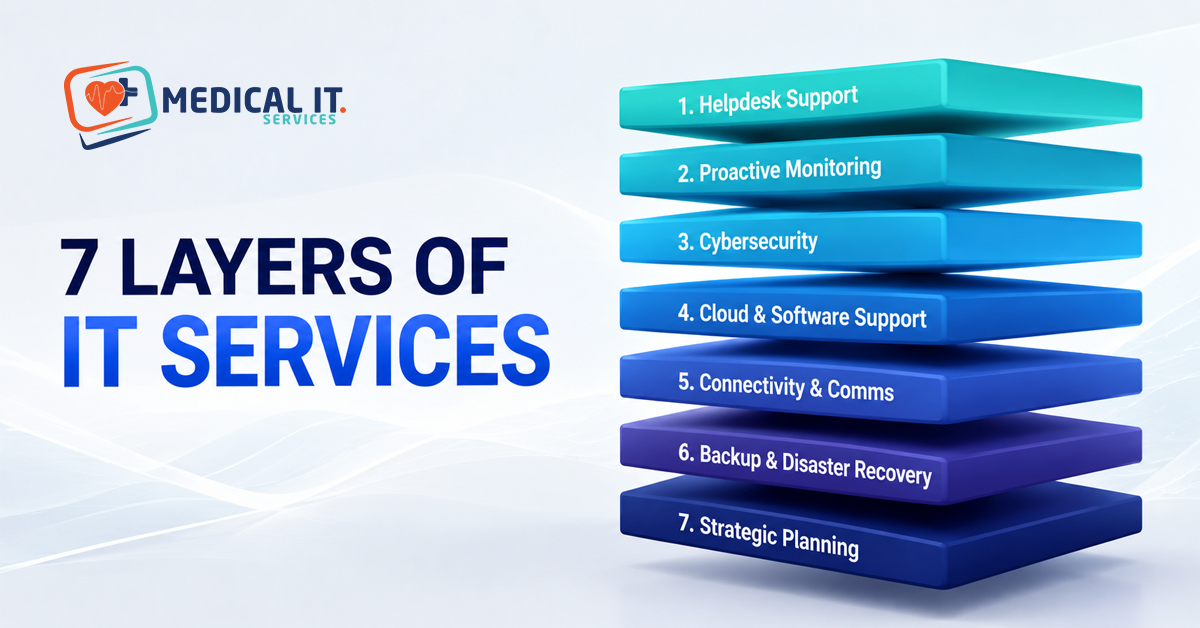
Cybercrime reports from small businesses rose sharply in the past financial year, and unplanned downtime now costs Australian small businesses between $500 and $2,000 an hour once you factor in lost revenue, idle staff, and recovery time. Against that backdrop, essential business IT support services are no longer optional; they’re closer to insurance or a lawyer: something every business relies on quietly, until the day it’s no longer available. This guide covers the core IT services every Australian company should have in place, then looks at what medical and allied health practices specifically need on top, given the higher stakes of handling patient data.
1. Why Essential IT Support Isn’t Optional Anymore
IT support has moved from a reactive, break-fix arrangement to something businesses rely on continuously, much like they rely on their accountant. Three forces are driving that shift: rising cybercrime, tightening compliance expectations, and the real cost of downtime.
The Australian Cyber Security Centre’s most recent Annual Cyber Threat Report recorded 84,700 cybercrime reports across the country, roughly one every six minutes, with average incident costs for small businesses sitting around $56,600, up 14% year on year. That’s not a risk a business can reasonably choose to ignore.
2. Cybersecurity: The Non-Negotiable Layer
Cybersecurity sits inside managed IT support, but it deserves its own line item because it’s the layer insurers, regulators, and most actively targeted by attackers. At minimum, this should include:
- Managed firewall and endpoint protection on every device
- Email filtering and phishing protection
- Multi-factor authentication (MFA) across all business systems
- Staff security awareness training
- Incident response planning — documented, not theoretical
Cyber insurance is a useful forcing function here. Most insurers require controls such as MFA, endpoint detection, and robust backups, and may restrict coverage or impose additional conditions where those controls are absent.
3. What Medical and Allied Health Practices Need on Top
A general business checklist covers the fundamentals, but medical and allied health practices carry obligations that go well beyond generic IT support, for one simple reason: health information is classified as sensitive under Australian privacy law, and the Privacy Act’s small business exemption does not apply to health service providers, regardless of turnover.
On top of the essentials above, practices need:
- RACGP Standards compliance: The RACGP Standards for General Practices (5th edition) include specific information security criteria, most notably Criterion C6.4, which requires a designated person responsible for IT security, individually assigned login credentials, and a documented business continuity plan.
- My Health Record security obligations and practices connected to My Health Record are expected to meet RACGP computer security guidance and keep clinical software securely configured; non-compliance can draw enforcement attention from the OAIC.
- Clinical software expertise: genuine experience supporting platforms like Best Practice, MedicalDirector, Cliniko, or Nookal, not just general Windows and Microsoft 365 support.
- Faster response times: a system-down issue during clinic hours directly blocks patient care and billing, so a response time of less than one hour is a reasonable baseline, not a premium extra.
- Documented breach procedures: the Notifiable Data Breaches scheme requires practices to notify the OAIC and affected patients when a breach is likely to cause serious harm; your IT provider should have a documented, tested procedure for this before you ever need it.
The consequences of getting this wrong are no longer hypothetical. In October 2025, the Federal Court ordered Australian Clinical Labs to pay a $5.8 million civil penalty, the first-ever civil penalty under the Privacy Act following a 2022 ransomware breach that exposed the sensitive health information of more than 223,000 individuals. The Court found ACL had failed to take reasonable steps to protect that information, failed to properly assess the breach once suspected, and failed to notify the regulator promptly. It’s a concrete reminder that “reasonable steps” under the Privacy Act is a standard regulators are now actively willing to enforce, not just a phrase on a policy document.
4. Managed IT vs Break-Fix: Why the Model Matters
Break-fix support is reactive by design: you call someone when something breaks. Managed IT support is structured to prevent breakage in the first place: continuous monitoring, scheduled patching, and a provider who’s accountable for uptime rather than paid by the callout.
For any business where downtime has a real cost, and for medical practices, where downtime can prevent patients from being seen, the managed model is generally the more defensible choice, even though the sticker price looks higher month to month.
5. What Should Be in Your SLA
- Response times, split by severity — a critical outage should be treated differently from a minor request.
- Resolution time targets, not just acknowledgement times.
- What’s included vs billed separately — a long feature list means little if the things you need are add-ons.
- Reporting metrics, such as first-call resolution rate and system reliability percentage.
- Contract flexibility — understand any lock-in terms before signing.
6. A Simple Readiness Checklist
- 24/7 monitoring and a responsive help desk with defined resolution times
- Multi-factor authentication across all business systems
- Tested, off-site data backups with disaster recovery documented
- Patch management running on a defined schedule
- A documented incident response and breach notification plan
- A clear SLA with response times split by issue severity
- For medical practices: RACGP Standards alignment and clinical software expertise confirmed with your provider
Conclusion
Every Australian business needs the same foundation: monitoring, help desk support, patching, backups, and genuine cybersecurity not as add-ons, but as standard. For medical and allied health practices, that foundation is the starting point, not the finish line. The classification of health information as sensitive information, the exclusion of health service providers from the Privacy Act’s small business exemption, and the accreditation requirements associated with the RACGP Standards mean that what is adequate for a general business may not be sufficient for a medical practice.
If you’re not confident your current IT support covers what your practice needs, including compliance, Medical IT.Services can assess your setup against the RACGP Standards and Essential Eight and show you exactly where the gaps are. Get in touch for a free IT assessment.
Related Posts