Why IT Support for Healthcare Requires Specialised Knowledge of Clinical Systems and Patient Privacy
Most managed IT providers list healthcare as one of several industries they serve, right alongside…


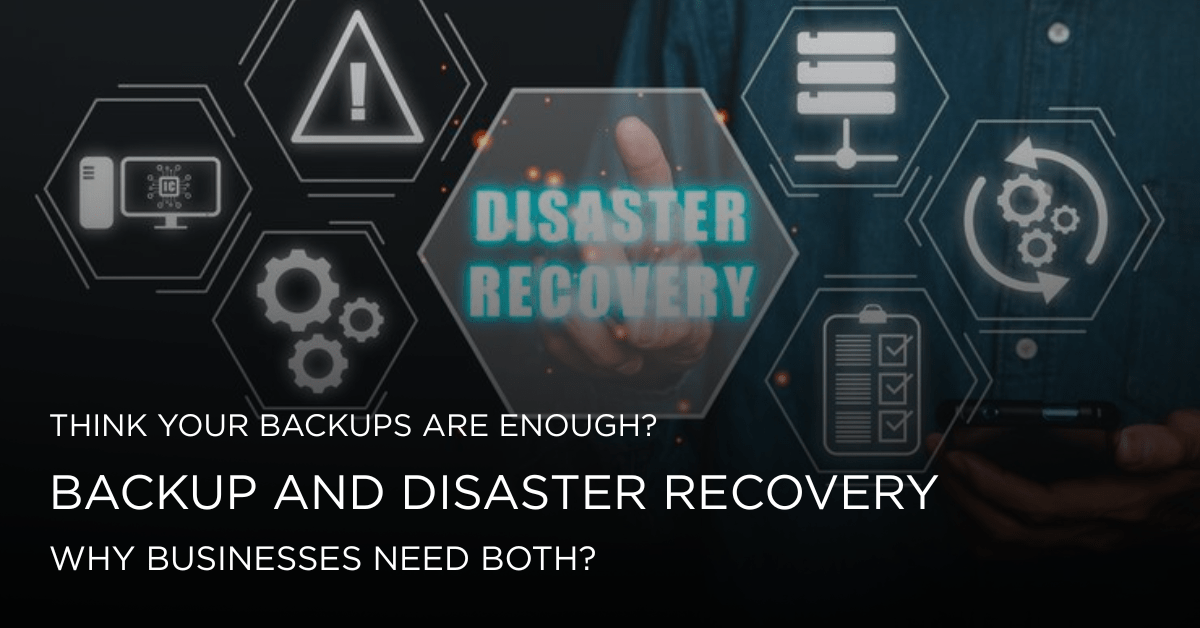
In today’s digital world, where every piece of information is stored, businesses of all sizes recognize the importance of preserving their backup and disaster recovery. You have probably heard the warning: Back up your files! So, you take action. You may have an external hard drive that backs up your company files nightly. Or perhaps you use a cloud service that automatically saves your documents. You feel secure. You have done your duty. Your data is safe.
But here is a critical question: if a real disaster struck your business right now—a fire, a major cyberattack, a flood—how long would it take you to get back to normal? Could you answer emails? It Could you serve your customers? Could you process orders? If your only answer is, “Well, we have our data saved on a drive or in the cloud,” then you might be in for a devastating surprise.
This is the crucial gap that many businesses fall into. There is a world of difference between simply having backup and disaster recovery processes and having a true, actionable plan. One is a single tool; the other is a complete survival kit. Understanding this difference is not just technical jargon—it is the key to your business’s resilience and long-term survival.
Let’s begin with the basics. A backup is just a copy of your data. It’s like making a copy of an essential paper and keeping it in a secure place. It’s easy: you want a second copy in case the first one is lost, broken, or deleted.
However, a backup has a limited scope. It answers the question: “Can I get my data back?” But it fails to address the more complex questions that arise during a major disaster.
A Disaster Recovery (DR) Plan is a comprehensive, documented strategy. It is a detailed blueprint that outlines how your entire organization will respond to and recover from a major disruptive event. Backups are only one part of this approach; they are not the whole thing.
A true DR plan goes far beyond data. It focuses on restoring your entire business operations. It answers important questions like:
Disaster recovery for IT is the technical engine that powers this plan. It involves the specific technologies and processes—like having a secondary data centre or cloud infrastructure—that can “spin up” your critical servers and applications when your primary ones are destroyed.
Think of it this way:
Relying solely on backups during a major disaster is like having a life jacket but no lifeboat on a sinking ship. The life jacket (your backup) might keep you afloat, but you are still stranded in the middle of the ocean. The lifeboat (your DR plan) is what gets you to safety.
Consider these real-world scenarios:
In particular, the risks of having only backups are immense: extended downtime, permanent loss of customers, reputational damage, financial penalties, and, in the worst cases, total business failure.
Creating a DR plan may seem daunting, but it is a manageable process. For businesses in Australia, considering local challenges like bushfires, floods, and cyber threats is essential. This is where seeking disaster solutions Australia-based experts can be invaluable, as they understand the local context.
Here is a simplified step-by-step guide:
Assign roles and responsibilities. This should include people from management, IT, operations, and communications.
This is the most critical step. Identify all your business processes and the IT systems that support them. Then, ask:
This analysis will define your RTO and RPO for each system.
To illustrate, and create a complete inventory of your hardware, software applications, data, and network infrastructure. You cannot recover what you do not know you have.
This is where you choose your disaster and recovery technologies. How will you recover each critical system?
In particular, document everything clearly. The plan should include:
A plan that has not been tested is just a theory. Schedule regular tests. Start with a tabletop exercise (walking through the plan on paper) and progress to a full-scale simulation. Testing reveals flaws and ensures your team is prepared.
Your business and technology change. Your DR plan must be a living document, reviewed and updated at least every six months or after any major change to your IT environment.
Many businesses, especially small and medium-sized ones, lack the in-house expertise or time to build and maintain a robust DR plan. This is where professional disaster recovery services become a strategic investment. These providers specialise in disaster and recovery. They offer:
When looking for disaster solutions Australia, choose a provider with a proven track record, local support, and a solution that aligns with your business’s specific RTO and RPO requirements.
In conclusion, the digital landscape is filled with threats, both seen and unseen. Above all, assuming that your backups are a sufficient safety net is a dangerous form of complacency. Backups are about saving your past data. A Disaster Recovery Plan is about saving your future business.
The journey from simple backups to a true DR plan is a shift in mindset—from being reactive to being proactive. It is an investment in continuity, resilience, and confidence. It is the difference between telling your customers, “We’ve been hit by a disaster and we’re trying to figure it out,” and being able to say, “We’ve experienced a disruption, but our systems are designed for this. We are already recovering, and it will be business as usual very soon.”
Do not wait for a disaster to reveal the gap in your strategy. Start the conversation today. Assess your current backups, begin drafting your plan, and consider partnering with experts. Because in the world of business continuity, the critical difference between simple backups and a true disaster recovery plan is the difference between hoping to survive and knowing you will.