Why IT Support for Healthcare Requires Specialised Knowledge of Clinical Systems and Patient Privacy
Most managed IT providers list healthcare as one of several industries they serve, right alongside…


In today’s modern era, the use of computers, internet and various software has become very common for every business. Be it small or big business, everyone performs their daily tasks through these things. But as the use of technology is increasing, the risks of cyber attacks i.e. hacking, viruses and data theft are also increasing. For this reason, it has become very important for businesses to keep their systems and data safe.
The role of a Managed Service Provider (MSP) becomes important to fulfill this need. An MSP is a company that provides IT-related services to other businesses in exchange for a monthly fee. This company maintains computer systems, runs the network properly and keeps the software updated so that no malfunctions occur. If any kind of problem arises, the MSP also resolves it immediately.
Along with this, MSP also pays special attention to cyber security so that the business data remains safe and any kind of online threats can be avoided.
Cyber security means protecting your data, computer systems, and networks from all kinds of online threats. Nowadays, most businesses store their important records, customer information, and financial data in digital form, so protecting it becomes very important. If there is no proper security, hackers can easily enter the system and steal valuable information.
Due to weak cyber security, a company can not only suffer financial losses but also its reputation. If customer data is leaked, people’s trust decreases, which is very harmful for any business. In addition, viruses and malware can corrupt systems, which stops work and increases further costs.
That is why it is important for every business to adopt strong cyber security to keep its data safe and continue to operate without any interruption.
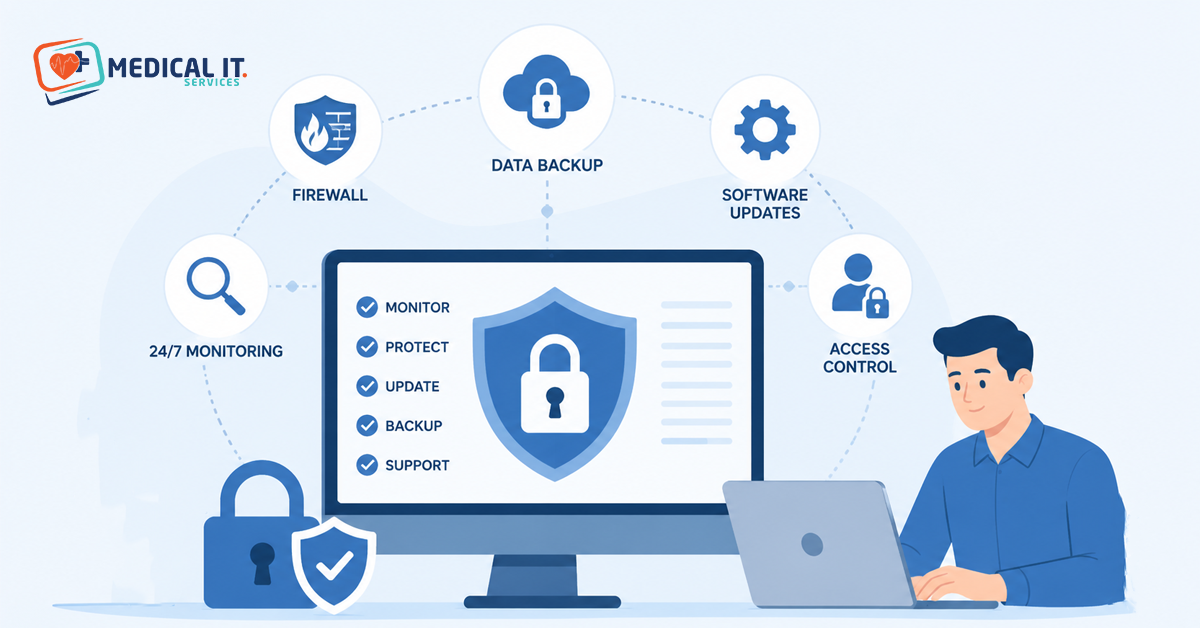
The MSP monitors the business network at all times, meaning that the system is monitored day or night. The goal is to identify any unusual or suspicious activity immediately. For example, if an unauthorized person tries to enter the system or if there is a sudden unusual movement of data, the MSP takes immediate action. This continuous monitoring prevents problems from occurring at an early stage, which can prevent major damage. This way, the business can continue its work without interruption and the security risk is reduced.
The MSP installs modern antivirus and firewall systems to protect the system from viruses, malware and hacking. Antivirus software identifies and eliminates harmful files entering the computer, while the firewall acts like a wall that blocks unsecured or suspicious internet connections. The advantage of this is that the company’s network remains secure and it becomes difficult for hackers to enter the system. MSP also updates these security tools periodically so that they can combat new threats.
MSP ensures that all software and systems are always up to date. Old software often has security vulnerabilities that can be easily exploited by hackers. When the software is updated, these vulnerabilities are fixed. MSP installs updates automatically so that the user does not have to worry. It is also seen that no update is harmful to the system. This process not only improves security but also improves system performance.
MSP takes regular backups of important data so that if the data is lost for any reason, it can be recovered. For example, if the data is lost due to hacking, virus or any technical fault, it can be brought back through backup. This backup is usually kept on secure servers or in the cloud. MSP also ensures that backups are working properly. This gives businesses peace of mind that their important data is always safe and can be retrieved in any difficult time.
MSP determines which person can access the system to what extent through user access control. Each employee is given permissions according to their job, so that they only have access to the necessary information. The advantage of this is that sensitive data is not available to everyone and the risk of misuse is reduced. If an employee leaves the company, their access is immediately terminated. This way the system remains more secure and insider threats are also reduced.
The managed service provider (MSP) not only protects the systems but also educates staff on the importance of security. Phishing emails, how to avoid clicking on strange links, and how to keep passwords secure are all topics that are covered in the security training that they receive. The majority of cyber attacks are the result of human error; therefore, awareness is absolutely necessary. The MSP offers its personnel with frequent training sessions and guidelines in order to maintain their vigilance. By doing so, the entire security of the firm is improved, and risks are consequently reduced.
Managed Service Provider provides a complete solution for businesses that includes IT support as well as strong cyber security. This not only solves day-to-day problems but also keeps the company’s data safe. That is why choosing an MSP is a wise decision in today’s era.