A receptionist left in March, and her login still works. One laptop hasn't been patched…
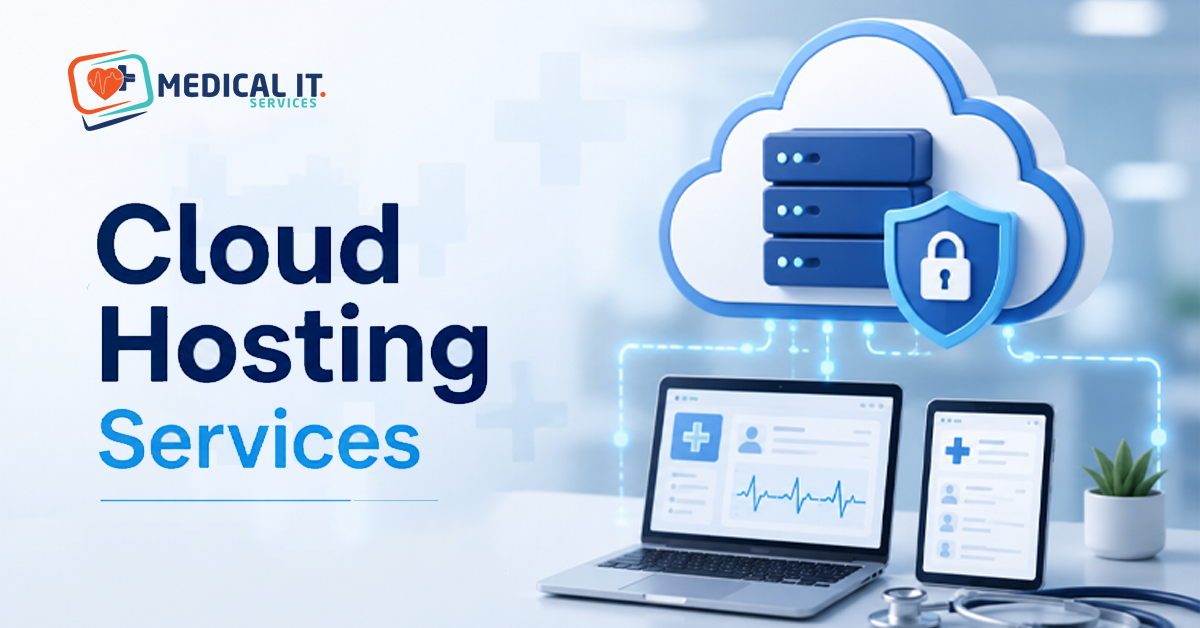
What Cloud Hosting Services Include Beyond Storage and Basic Server Resources
Cloud Hosting Services for Australian medical practices has become one of the most important infrastructure decisions a clinic can make, and one of the most misunderstood. Many practice managers think cloud hosting means storing files online. A well designed cloud solution touches every part of how your practice operates: how quickly patient records load, how securely data is protected, whether you can pass a RACGP accreditation audit, and how your practice recovers if ransomware strikes at 3 pm on a Tuesday.
This guide is written for Australian healthcare providers, GPs, specialists, allied health clinics, and multi-site medical groups who want to understand what cloud hosting truly delivers, what Australian compliance obligations apply to patient data in the cloud, and how to choose the right cloud solution for your practice.
What Is Cloud Hosting for Medical Practices?
Cloud hosting for medical practices means running your clinic’s IT infrastructure servers, data storage, practice management software, and communication tools on remote servers managed by a specialist provider, rather than on physical hardware at your premises.
For an Australian GP clinic or specialist practice, this typically includes hosting for clinical software such as Best Practice, Medical Director, or Genie Solutions; secure storage of electronic patient health records; email, video conferencing, and collaboration tools; and network infrastructure for reception, consulting rooms, and administrative staff.
The key difference between consumer cloud storage (like Dropbox or iCloud) and a healthcare-grade cloud hosting solution is compliance. Patient health information in Australia is governed by the Privacy Act 1988 (Cth), the My Health Records Act 2012, and state-based health records legislation; your cloud infrastructure must reflect these obligations.
What Cloud Hosting Actually Includes
The most common misconception about cloud hosting is that it’s simply an online hard drive. A properly designed healthcare cloud hosting solution encompasses far more:
1. Automated Backup and Disaster Recovery
Healthcare cloud platforms provide automated, encrypted backups of your patient records, billing data, and clinical documents, typically to geographically separated Australian data centres. This means that if your primary server fails or a ransomware attack encrypts your local files, your data can be restored quickly from a clean backup.
The Australian Cyber Security Centre (ACSC) reports that healthcare organisations are among the most frequently targeted sectors for ransomware in Australia. Without robust automated backups, a single cyberattack can render a practice inoperable for days or weeks.
2. Advanced Security and Threat Protection
Enterprise-grade healthcare cloud hosting includes next-generation firewall protection, real-time intrusion detection, DDoS mitigation, and data encryption both in transit and at rest. For Australian medical practices, encryption of patient health information is not just best practice, it is an obligation under the Australian Privacy Principles (APPs) contained in the Privacy Act 1988.
3. Scalability for Growing Practices
Cloud infrastructures allow the ability to scale IT resources as medical practices grow. Whether you’re adding a new GP, opening a second site, or onboarding a bulk-billing telehealth service, your cloud environment can expand without the cost and delays of procuring new physical hardware.
4. Automation and Centralised Management
Healthcare cloud platforms include automated patch management (keeping your operating systems and clinical software up to date), compliance monitoring and audit logging (essential for RACGP accreditation and Privacy Act compliance), and centralised management dashboards that give your IT provider real-time visibility of your environment.
5. High-Performance, Low-Latency Networks
Clinical software such as Best Practice and Medical Director requires fast, reliable connectivity to function smoothly during consultations. Healthcare cloud infrastructure connects to high-performance Australian data centre networks to ensure that patient records load instantly and clinical workflows are never disrupted by slow connections.
Australian Healthcare Compliance and Cloud Data Obligations
This is the section that most generic cloud hosting articles miss entirely, and for Australian medical practices, it is the most important.
1. Privacy Act 1988 (Cth) and the Australian Privacy Principles
The Privacy Act governs how organisations collect, store, use, and disclose personal information, including sensitive health information. Under Australian Privacy Principle 11 (APP 11), healthcare providers must take reasonable steps to protect health information from misuse, interference, loss, and unauthorised access. A cloud services provider must demonstrate that their infrastructure meets the standards of the Australian Privacy Principles Act (1988)
2. Health Records Act 2012
If your practice participates in the My Health Record system, you have additional obligations regarding how patient data is accessed, stored, and protected. Cloud services provider infrastructure must be compatible with the My Health Record system’s security requirements. And it cannot enable unauthorised access to My Health Record data.
3. RACGP Standards for General Practices
The RACGP’s Standards for General Practices (5th Edition) address electronic information management, including requirements for data security, backup procedures, and access control. Cloud hosting providers work with GP support clinicians. And they should be aware of these standards and be able to demonstrate compliance with security.
Cloud hosting providers working with GP clinics should be familiar with these standards and able to demonstrate compliance.
4. Notifiable Data Breaches Scheme
Under the Notifiable Data Breaches (NDB) scheme, healthcare providers must notify the Office of the Australian Information Commissioner (OAIC) and affected individuals if a data breach is likely to result in serious harm. A healthcare cloud provider should include incident response planning and breach notification support as part of their managed service.
Why Patient Data Must Stay in Australia
Data sovereignty is the principle that data is subject to the laws of the country in which it is stored. For Australian medical practices, this means that patient health information should be stored in Australian data centres, not in US, European, or Asian facilities operated by international cloud providers.
When patient data is stored offshore, it may be subject to foreign government access requests (such as the US Cloud Act), may not comply with Australian Privacy Principle requirements, and may create legal exposure for your practice in the event of a breach.
Medical IT Services operates exclusively with Australian-based data centres that are independently certified to ISO 27001 and, where applicable, hold certification under the Australian Signals Directorate (ASD) Certified Cloud Services List (CCSL).
Clinical Software and Cloud Compatibility
One of the most practical considerations for Australian medical practices migrating to the cloud is clinical software compatibility. The most widely used practice management and clinical software in Australia includes:
- Best Practice Software supports cloud deployment via a Terminal Server / Citrix or Azure Virtual Desktop environment
- Medical Director supports cloud and hosted environments through Medical Director Cloud and third-party hosting
- Genie Solutions is available as a cloud-hosted solution with Genie Cloud
- Zedmed offers cloud-hosted deployment with Australian data sovereignty
- HotDoc, Clinic to Cloud, and other patient engagement platforms are all cloud-native with API integrations
A healthcare IT specialist will assess your current clinical software environment and design a cloud hosting solution that ensures clinical workflows remain uninterrupted during and after migration.
Cybersecurity Features Healthcare Cloud Must Have
The ACSC’s ASD Essential Eight provides a baseline cybersecurity framework that all Australian organisations, including healthcare providers, should implement. From a cloud hosting perspective, the most critical controls are:
- Application Control: Only approved applications can be executed in your cloud environment
- Patch Applications automatic internet-facing service patching within two weeks
- Restrict Administrative Privileges. Restrict administrative accounts with multi-factor authentication
- Multi-factor authentication: All devices and cloud administration require multi-factor authentication
- Daily Backups encrypted, offsite backups with tested restoration procedures
- Patch Operating Systems: Cloud OS patching within one month of release
Our healthcare cloud hosting platform is designed to match Essential Eight Maturity Level 2. In Australia, practices with enhanced security can also choose Maturity Level 3.
Disaster Recovery and Business Continuity for Medical Practices
Medical practices’ downtime is not only an inconvenience. And it would cause a delay in patient care, disrupt prescriptions, and create legal and reputation problems. A healthcare cloud hosting solution should include a documented Disaster Recovery Plan (DRP) that defines:
- Recovery Time Objective (RTO): how quickly systems must be restored (typically 4 hours for clinical systems)
- Recovery Point Objective (RPO): the maximum amount of data that can be lost (typically 1–4 hours)
- Failover procedures automatically or manually switch to a secondary data centre if the primary fails
- Backup verification: regular testing of backup restoration to confirm data integrity
- Incident response defines the steps if a cyberattack or data breach occurs
Scalability and Telehealth Infrastructure
Since the rapid expansion of telehealth services during and after COVID-19, Australian medical practices have new infrastructure requirements. A cloud environment designed for telehealth must support high-definition video conferencing, secure messaging, and integration with Medicare telehealth billing systems without degrading the performance of in-clinic systems.
Cloud hosting enables practices to spin up telehealth capacity on demand, support GPs working from home securely, and connect multi-site practices without expensive private WAN links.
How Medical IT Services Support Healthcare Cloud Hosting
Medical IT Services specialises exclusively in IT solutions for Australian healthcare providers. Our cloud hosting service is purpose-built for the compliance, security, and clinical software requirements of GP clinics, specialists, allied health providers, and multi-site medical groups.
Our healthcare cloud hosting includes:
- Australian-based, ISO 27001-certified data centres with guaranteed data sovereignty
- Best Practice, Medical Director, and Genie Solutions cloud deployment and support
- Privacy Act and My Health Records Act compliance by design
- ACSC Essential Eight alignment (Maturity Level 2 baseline)
- Automated encrypted backups with 4-hour RTO / 1-hour RPO
- 24/7 monitoring and incident response
- Telehealth infrastructure setup and ongoing support
- RACGP accreditation support IT evidence documentation prepared for your audit
- Scalable licenses add users, sites, or storage as your practice grows
Conclusion
Cloud hosting for Australian medical practices is not simply about moving your files online. It is a strategic decision that touches compliance, security, business continuity, clinical software performance, and patient trust. Getting it right means choosing a provider who understands the Privacy Act, the My Health Records Act, RACGP standards, and the ACSC Essential Eight, not just one who knows how to set up a server.
Medical IT Services is Australia’s specialist healthcare IT provider, with deep expertise in cloud hosting, compliance, and clinical software support for GP clinics, specialists, and allied health organisations. Our cloud solutions are built for healthcare, not adapted from generic IT templates.
Ready to move your practice to a secure, compliant cloud environment? Get in touch with our expert to get a free cloud setup assessment.
Related Posts