What Break-Fix and Managed IT Actually Mean Break-fix support is exactly what it sounds like:…
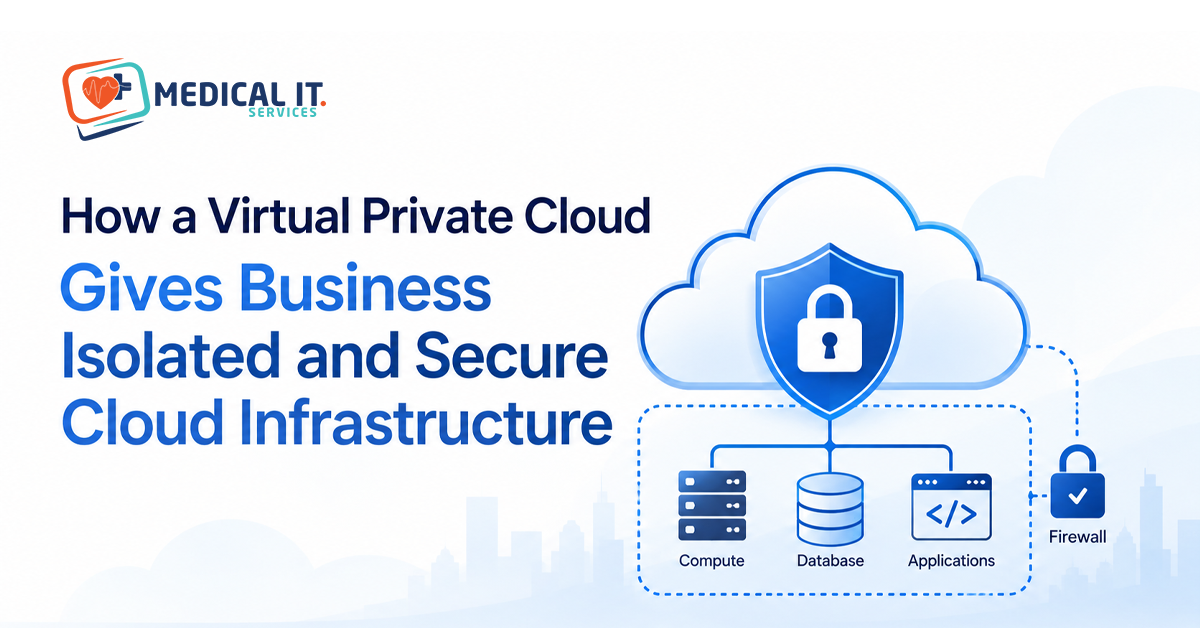
How a Virtual Private Cloud Gives Business Isolated and Secure Cloud Infrastructure
Cloud services are being used by majority of today’s enterprises to safeguard their data and applications in this digital era. But when it comes to security and privacy, every corporation wants its data to be totally protected. This necessity led to the Virtual Private Cloud (VPC).
A VPC is basically a private network that runs inside the public cloud, but only a specific company has access to it. In addition, VPCs also have features such as firewalls and encryption, which greatly reduce the risk of data theft or leakage. Even the largest companies prefer VPC in sensitive sectors like banking, healthcare and e-commerce.
VPC is a secure room that exists in a public building, but only you have the key to it. Therefore, most businesses today are using a virtual private cloud to protect their data from online threats.
Why is VPC important for business?
Improved security:
Virtual Private Cloud (VPC) provides the best security measures to protect company data from unauthorised access and theft. In this, businesses can create their own firewall rules, that is, they can decide who can come in and who can’t. The company also controls access options, such as which employees can see which data. This is why VPC is preferred in sensitive locations like banks, health centers and large online shops. This way the data is always secure and private.
Full control:
A virtual private cloud (VPC) gives organisation complete control over its network. They can assign IP addresses anyway they like, making each machine unique, like a home address. Subnets, i.e. small parts of the network, can also be self-organised, so that data from different regions remains separate. Other network settings, such as routing tables, are also automated. With this control, the company can create exactly the environment it needs, just like its office.
Data Privacy:
VPC offers a fully secure and private environment, fully insulated from other companies’ data. So critical information like client names, addresses, bank accounts and passwords are safer. Because it’s a private network the possibility of data leaking is significantly decreased. This data is not simply available to any outsider or any other firm. This means that corporate secrets and consumer information is always kept confidential which builds trust in business.
Better performance:
An organisation’s applications and services run in an organised and secure VPC network, and their speed and performance improve. There are no unnecessary interruptions, no repeated checking of data. It works faster, loading time is reduced, and employees can work without interruption. This advantage is critical for firms that have thousands of visitors on their websites or services within seconds. Better performance leads to happy consumers and higher income.
Easy Scaling:
As the company expands, it will need more data as well as new applications. Scaling i.e. increasing resources in VPC is very easy. The company does not need to buy new machines or build a new network. They can add more space, more power and new features to her cloud with just one click. Consequently, the virtual private cloud (VPC) may expand in tandem with the expansion of the company. This is particularly helpful for new businesses and firms that are just starting out.
Common uses of VPC
Hosting websites and web applications:
Using VPC, companies can keep their websites and web applications securely online. Whenever a user opens a website, their data travels within a private network, which no outsider can see. It benefits e-commerce stores, blogs, and news websites. The risk of attacks such as hacking or data theft is greatly reduced. Businesses can increase resources at will when more people visit the website, without any interruption.
Protecting Database Servers:
Database servers are where all the company’s customer, product, and transaction data resides. Placing a database in a VPC means that only authorised applications and logs can access it. For example, if a bank’s database is in a VPC, a hacker cannot touch it from the outside. Through firewall rules, the company itself determines which applications can connect to the database, which reduces the risk of data leakage to almost zero.
Running Enterprise Software:
Large companies run complex software such as ARP, CRM, and accounting. These software are very sensitive and need a secure and stable environment. By running them in a VPC, businesses can be sure that no other company or person can access the software’s data. Also, speed and performance remain good. Employees can use this software securely whether they are sitting in the office or at home.
Backup and Disaster Recovery Systems:
Sometimes a natural disaster occurs, a system crashes, or an attack occurs – in which case data can be lost. In a VPC, companies keep a backup of all their data. This backup is stored in a separate location. If the original data gets corrupted, this copy immediately starts working, exactly as it was before. This is called disaster recovery. In this way, the business resumes in a few minutes, and the customers are not disturbed.
Securing a remote working environment:
Today, many employees work from home. But when they move from the home network to the company’s system, there is a risk of data theft. VPC is the solution to this problem. Employees connect to the VPC through a secure tunnel (VPN), such as an encrypted tunnel. All data is encrypted, that is, no one can see it secretly. And, employees can safely access the company’s private data even while sitting at home.
Conclusion
Virtual Private Cloud (VPC) is an effective solution for modern businesses that improves security, privacy and control. It helps companies to secure their data and applications by taking advantage of the cloud. That’s why small and large businesses around the world are increasingly using VPC.
Related Posts